B-track User Guide
Record behavior, see change on a graph — how to use B-track
B-track records a child's behavior by frequency, duration, ABC, and accuracy, and shows change on a trend graph placing baseline and intervention side by side — free, with no child's real name collected. This guide has two parts: ① how to use B-track, and ② the Behavior Intervention Plan (BIP) feature within it.
B-track basics
Four steps and you're done
Register a child by code, define the behaviors to decrease or increase, then log quickly each time you observe. Records are split into baseline and intervention and organized automatically into a trend graph.
- 1
Register a child
Add a child with ‘+ New child’. No real name, day of birth, or address is collected — only an internal code and alias (e.g., ‘Sunshine-class boy’), birth year, and sex. Diagnosis group is optional.
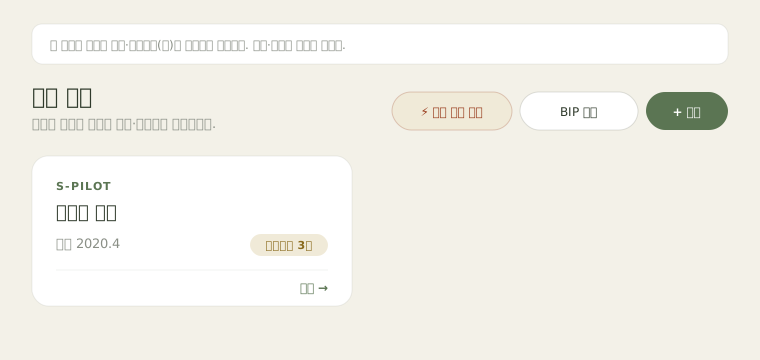
💡 Not entering identifiers is the core of privacy protection here. You're warned not to put a real name in the alias.
- 2
Define target behaviors
Set problem behaviors to decrease and replacement/skill behaviors to increase. For each, pick a measurement — how often (frequency), how long (duration), antecedent/consequence (ABC), or percent correct (accuracy).
- 3
Record behavior
Pick the date and ‘baseline/intervention’, then log fast from the cards. Frequency auto-saves on each +/- tap; for accuracy, enter trials and correct and the rate is computed. Add ‘+ ABC’ for antecedent/consequence/function when needed.
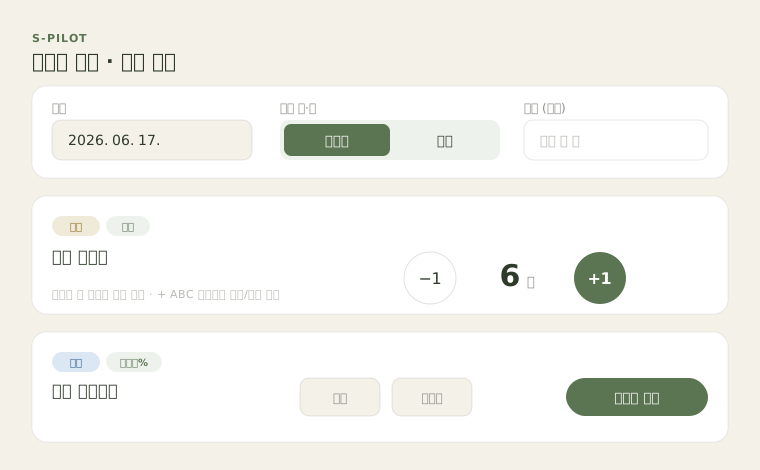
💡 The baseline/intervention choice defines the intervention line on the graph — so set it each time. (The baseline concept is explained in PART 2.)
- 4
See change on the SSD trend graph
On the child's detail page, the ‘Trend graph’ shows baseline and intervention side by side per behavior. Phase means, decrease/increase rate, and the intervention line are drawn automatically, with an auto-analysis note.
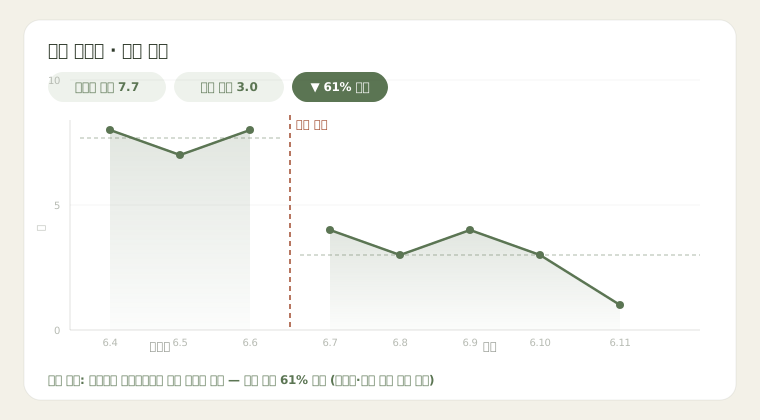
💡 Use ‘Quick log today’ for fast +/- on frequency, and export a clinical black-and-white PDF.
That covers B-track's core recording. Below is the Behavior Intervention Plan (BIP) feature built on those records. BIP is a sub-feature of B-track — from a recorded child, ‘BIP draft’ auto-fills the problem behaviors and estimated functions. First, what a BIP is and why functional assessment matters.
1. What is a BIP
A Behavior Intervention Plan — support matched to the why
A Behavior Intervention Plan (BIP) identifies why a problem behavior happens (its function) and documents ① antecedent strategies that prevent it, ② response strategies for when it occurs, and ③ instruction of a replacement behavior that serves the same function.
As behavior support—and the new behavior intervention specialist role—becomes institutionalized in special education, teachers familiar with IEPs are increasingly asked to write BIPs as well. If the IEP answers 'what to teach', the BIP answers 'how to support behavior'.
A typical standard form has the nine parts below.
Prevent — antecedent strategies
Adjust the environment, tasks, and routines before the behavior occurs to reduce its reason.
Respond — response strategies
When the behavior occurs, respond consistently so the behavior stops working.
Teach — replacement behavior
Teach an appropriate behavior (asking, waiting) that serves the same function.
Nine sections of the standard form
Key idea: a good BIP is not a list of 'don'ts' — it teaches something the student can do instead that serves the same purpose.
2. What is FBA
Behavior has a reason — finding the function
A child's behavior is not random. Screaming, leaving the seat, throwing objects — these persist because they work for the child: they get something or avoid something. That effect is the behavior's function, and estimating it is Functional Behavior Assessment (FBA).
Interventions chosen without knowing the function often backfire. Sending a child to time-out for screaming that functions as task escape actually rewards the behavior — the child successfully escaped the task.
A Antecedent
Math task presented
B Behavior
Screaming
C Consequence
Task stops = escape works
The consequence right after the behavior (C) maintains it — here the function is escape, so time-out is actually a reward.
Direct observation (ABC)
Record Antecedent–Behavior–Consequence for each event. The most reliable basic method.
Interviews & screening surveys
Quickly estimate function from adults who know the child well. Screening only — confirm with direct observation.
Record review
Look for patterns (when, where, after what) in existing behavior and guidance records.
3. The four functions of behavior
Attention · Escape · Tangible · Sensory — with classroom examples
Most problem behavior is explained by one (or more) of four functions. The same 'screaming' can serve different functions in different children — look at the context, not the shape of the behavior.
Attention
- What
- Behavior maintained by reactions from adults or peers (looks, talk, laughter).
- Classroom example
- Makes loud noises while the teacher helps another student; pauses when the teacher approaches.
- Clues
- Watches for reactions while behaving; behavior subsides when attention is given.
- Support direction
- Provide planned, frequent attention for appropriate behavior and teach attention-requesting (raising a hand, calling a name).
Escape / avoidance
- What
- Behavior that removes a difficult or disliked task, situation, or stimulus.
- Classroom example
- Leaves the seat when a math task is presented; calms quickly when the task is removed.
- Clues
- Clusters right after task demands or transitions; stops when demands are reduced.
- Support direction
- Adjust task difficulty and length, offer choices, and teach asking for help or a break.
Tangible / access
- What
- Behavior that obtains a desired item or activity.
- Classroom example
- Drops to the floor when asked to put the tablet away; stops immediately when it is returned.
- Clues
- Escalates right after 'no'; stops as soon as the item is given.
- Support direction
- Teach waiting and turn-taking step by step, and build experiences of getting things by asking appropriately.
Sensory / automatic
- What
- Behavior maintained by the sensation it produces (sound, touch, movement).
- Classroom example
- Waves hands in front of the eyes or repeats the same sound even when alone.
- Clues
- Similar frequency regardless of others' reactions; occurs when alone.
- Support direction
- Provide safe alternative activities with similar sensory input and adjust environmental stimulation.
Caution: a behavior can serve more than one function, and functions can change over time. Always confirm an estimated function with direct observation.
4. Baseline & intervention
Why record first — the baseline story
A baseline records the current level of behavior before intervention. Without it, there is nothing to compare post-intervention change against.
Collect at least 3 sessions, until the data are stable. If the baseline is already improving (the behavior you want to reduce is dropping on its own), it is better to wait — starting now makes it hard to tell whether the change came from your intervention.
After intervention begins, keep recording the same way. Plotting the two phases side by side is the single-subject design (SSD) trend graph — the standard way to evaluate change within one child.
Example of a decrease-target behavior — read the two phases side by side at the phase-change line.
The ‘record from baseline’ idea here is the same as B-track recording in PART 1. For a child recorded in B-track, ‘BIP draft’ auto-fills the decrease-target behaviors and the function estimated from ABC — so your records flow straight into a plan draft.
Read it? Now record
B-track offers frequency, duration, ABC, and accuracy recording, SSD trend graphs, and BIP draft auto-fill — free. No child's real name collected.
This guide is general educational information and does not replace clinical judgment or professional assessment/consultation for an individual child.